
Turning a Mountain Bike Into a Fuel Cell Hybrid — The FC-Bike Demo
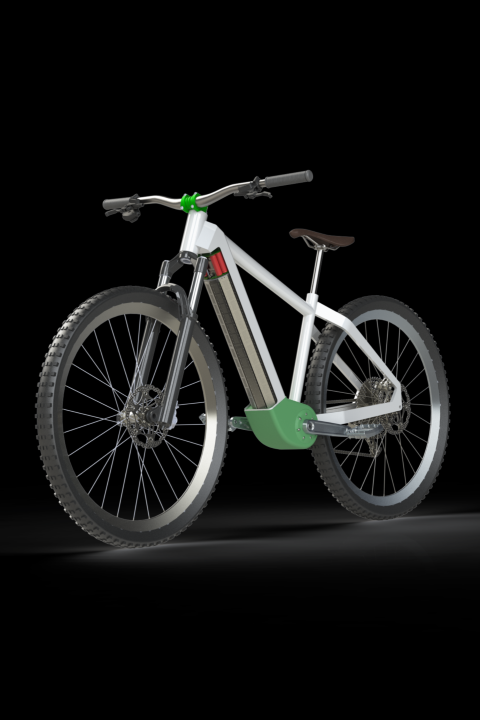
The idea was simple: take a standard MTB e-bike platform and completely rethink how it is powered. Instead of relying exclusively on a lithium battery, the goal was to integrate a Lamina-based hydrogen fuel cell system that works in hybrid mode — delivering continuous clean power while using the battery only as a buffer. The PoC was built to validate whether such a lightweight, compact fuel cell architecture could meet the dynamic requirements of cycling while remaining safe, silent, and seamlessly embedded inside the bike frame.
At the core of the system was a modular fuel cell strip assembly, using double Lamina FC strips combining membrane, gas diffusion layers, flexible printed circuits and integrated electronics. These strips formed the backbone of a small but highly efficient open-cathode fuel cell system capable of self-humidifying and cooling through passive natural convection, essential for a vehicle as exposed and weight-sensitive as a mountain bike. Air intake, a prerequisite for all open-cathode designs, was engineered into the frame geometry to ensure stable airflow without adding fans or external modules. The fuel cell output was regulated by a distributed control system: each strip had its own local control unit, while a Master Control Unit coordinated hydrogen flow, battery charging, and real-time system balancing.
The hydrogen side of the PoC introduced another layer of technical complexity: storing compressed hydrogen inside a bike frame.
To avoid having to manufacture a special designed Carbonfibre cylinder that would fit neatly in the bike’s frame, a repurposed Aluminium diving cylinder, designed for 300 bar nominal pressure, was fitted into the down tube and paired with a custom high-precision two-stage pressure regulator. A compact PEEK manifold distributed hydrogen evenly to all Lamina strips, and a proportionally controlled NC solenoid valve modulated the flow dynamically based on power demand. The hybrid logic was simple but powerful: when the rider demanded more power than the fuel cell’s continuous output, the battery delivered the peak; when power demand dropped, the fuel cell recharged the battery. An additional feature that was introduced is to regulate power-output based on fuel cell temperature, wenn riding slowly up a hill the battery takes more of the load and when going down the air speed will allow max fuel cell power recharging the battery. In practice, this created a smooth, responsive riding experience with significantly extended effective range and fast “refueling” by replacing or filling the hydrogen cylinder.
This PoC demonstrated that a fuel cell system can be engineered into a bicycle without compromising weight, packaging, safety, or ride feel. It proved that passive cooling is viable, that a modular lamina architecture fits the scale and vibration environment of a bike, and that hydrogen storage can be implemented safely inside a standard MTB frame. More importantly, it showed how a micro fuel cell can transform small electric vehicles — not by replacing batteries, but by complementing them to unlock far greater endurance.
Biography
Curious where this could go next? We are always looking for rebels with ideas — engineers, operators, integrators, and innovators who see potential where others see limits. If you have a use case, a challenge, or a concept that deserves cleaner, smarter power, let’s talk. Reach out, share your thinking, and help shape what hydrogen can enable next.